Smart Home vs Traditional Home: Which Saves More Energy in Malaysia? | Lumio Smart Home
Smart Home vs Traditional Home: Which Saves More Energy?
Energy efficiency has become a top priority for Malaysian homeowners as electricity costs continue to climb. But which type of home truly saves more energy — a traditional home or a smart home equipped with automation and AI?
Let’s break down the differences and see how modern technology is reshaping the way Malaysians manage energy.
What Defines a Traditional Home?
Traditional homes rely on manual operation of lighting, air-conditioning, appliances, and security.
This means:
Lights are switched on/off manually
AC settings remain fixed until someone adjusts them
Appliances may stay on even when not in use
No real-time awareness of energy usage
Key Weaknesses
High chance of energy waste
No automation
No occupancy-based adjustment
No usage insights
While traditional homes work, they’re not built for today’s energy challenges.
What Makes a Smart Home Different?
Smart homes use AI, sensors, IoT, and automation to optimize energy consumption.
They automatically adjust lighting, temperature, and appliances based on real-time conditions.
Energy-Saving Features Include
Motion sensors that turn lights off when no one is in the room
Smart thermostats that auto-adjust based on temperature and occupancy
AI routines that reduce unnecessary power usage
Real-time energy monitoring through the Lumio app
Visit:
👉 Lumio Smart Home Solutions
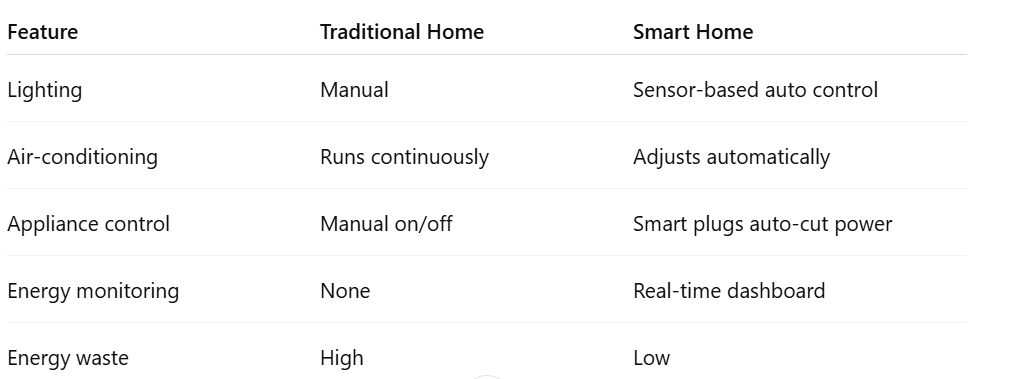
Smart Home vs Traditional Home – Energy Comparison
Below is a simplified comparison based on typical usage in Malaysia:
How Smart Homes Save More Energy
Smart homes can reduce energy bills by 20%–40%, depending on the level of automation.
Here’s how:
1. Automated Lighting Control
Traditional homes often leave lights on accidentally.
Smart homes use:
Motion sensors
Ambient light sensors
Auto-off timers
💡 This alone can reduce lighting energy by up to 30%.
2. Smart Air-Conditioning Efficiency
Air-conditioning is Malaysia’s biggest energy consumer.
Traditional AC often runs at full power even when not needed.
Smart homes use:
Temperature learning
Occupancy detection
Time-based cooling
🌡 Result: Lower electricity bills and more consistent comfort.
3. Real-Time Energy Monitoring
Traditional homes: No idea what’s consuming power.
Smart homes: Instant energy insights via dashboards.
With Lumio Energy Monitoring, you can identify:
High-consumption appliances
Hidden power leaks
Peak consumption periods
Data = savings.
4. AI-Driven Routines
Smart homes learn your daily patterns:
Wake-up time, when you leave home, sleep time, etc.
AI adjusts:
Lighting
Temperature
Appliance usage
All automatically.
5. Reduced Standby Power Loss
Traditional homes waste energy through idle appliances.
Smart plugs cut power automatically when devices are not in use.
Which Home Saves More Energy?
✅ Smart Home = Significantly More Energy Savings
❌ Traditional Home = Higher Electricity Costs
Based on automation, AI, and real-time control, smart homes clearly outperform traditional homes in energy efficiency, sustainability, and overall comfort.
Smart homes aren’t just the future —
they’re the financially smarter choice today.
Why Malaysians Are Switching to Lumio Smart Home
Lumio provides:
Smart lighting
Smart switches
Smart sensors
AI-powered automation
Energy monitoring
Smart security
All designed for Malaysian homes and lifestyles.
👉 View Solution: https://www.lumio.com.my/smarthome